
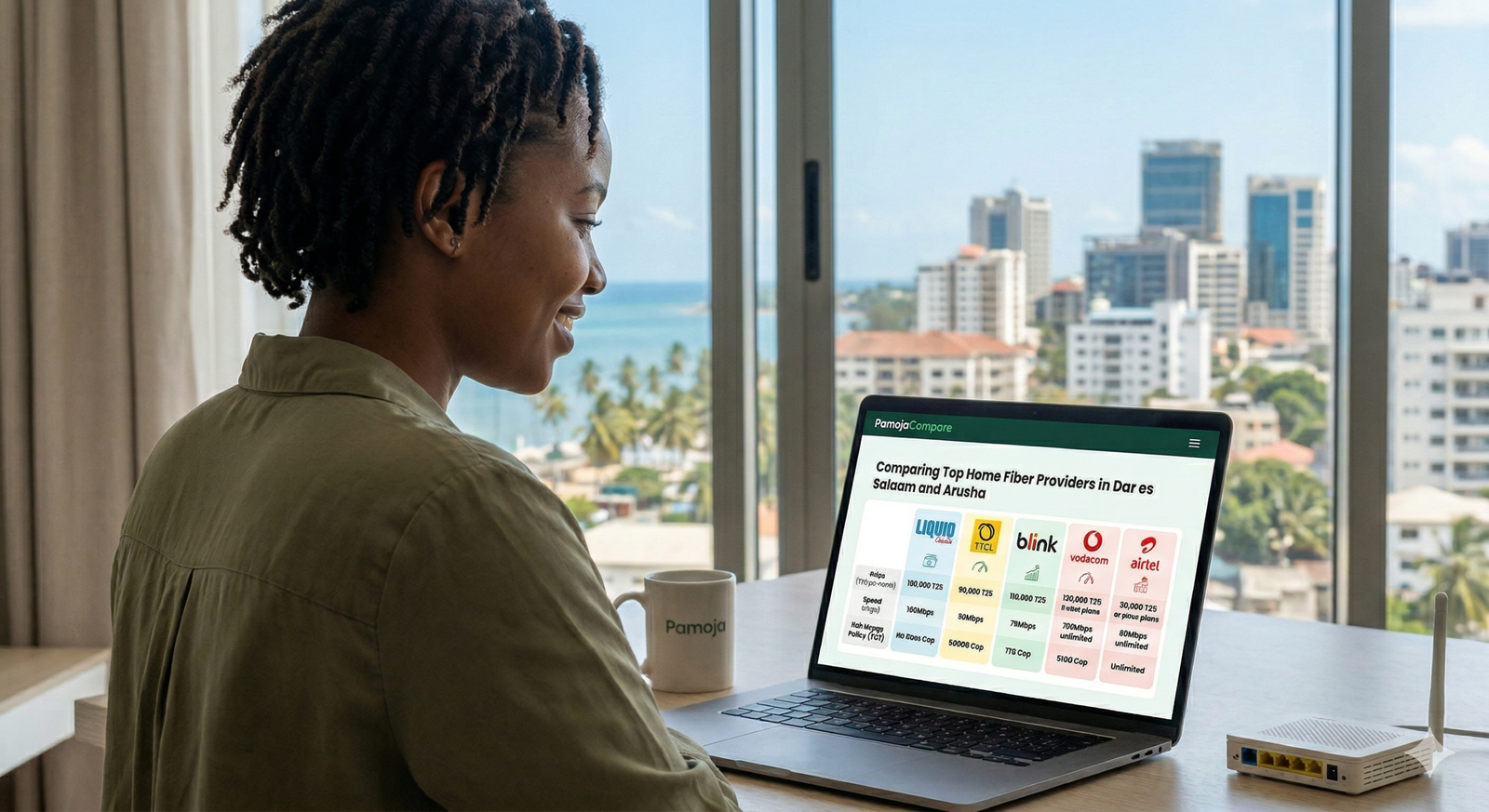
Choosing the right home internet in Tanzania can be confusing, especially with so many fibre and 5G options in Dar es Salaam and Arusha. This guide compares Liquid Home, TTCL (T‑Fiber), Blink, Vodacom Home Internet (SupaKasi / 5G), and Airtel Home Broadband on price, speed, data policy, and coverage, so you can see at a glance which provider suits your budget and location.
Liquid Home / Liquid Intelligent Technologies
- Standard Monthly Price for 20Mbps and 50Mbps plans (in TZS).
20 Mbps: about TZS 60,000 per month on Liquid Home fibre (Fibroniks 20 Mbps package). 50 Mbps: about TZS 100,000 per month on the 50 Mbps fibre package. - Installation Cost.
Liquid Home advertises free and fast installation in buildings that already have Hai/Liquid fibre infrastructure; in other areas, installation is subject to a site survey and a quoted fee rather than a fixed public tariff. - Fair Usage Policy (FUP) limits.
Residential fibre is sold as “unlimited” data, but Liquid explains that home users who do heavy downloads regularly during business hours may be deprioritised or advised to move to business packages; no specific monthly GB threshold is published for home fibre users. - Primary coverage areas in Dar and Arusha.
In Dar es Salaam, Liquid Home actively markets fibre in dense, higher‑income neighbourhoods including Upanga, Kinondoni, Masaki, Mwananyamala, Makumbusho and Msasani, along with other fibre‑ready buildings linked to its FTTH network. In Arusha, Liquid’s presence is mainly via backbone and business connectivity, so home fibre availability is building‑specific and must be checked via the online coverage checker or sales team.
TTCL (T‑Fiber / Faiba Mlangoni Kwako)
- Standard Monthly Price for 20Mbps and 50Mbps plans (in TZS).
20 Mbps: TZS 55,000 per month on the T‑Fiber Basic plan (20 Mbps down / 10 Mbps up). 50 Mbps: TZS 200,000 per month on the T‑Fiber Premium Streaming plan (50 Mbps down / 100 Mbps up), which is the nearest published 50 Mbps residential offer. - Installation Cost.
TTCL’s home‑products description for T‑Fiber states that fibre‑optic connection to the premises is done free of charge as part of its migration from copper to fibre, although customers still need compatible in‑home equipment such as a router. - Fair Usage Policy (FUP) limits.
T‑Fiber is described as a speed‑based service that provides an “unlimited shared experience” up to the subscribed speed; TTCL does not publish a monthly data cap for residential T‑Fiber packages. - Primary coverage areas in Dar and Arusha.
TTCL is expanding fibre across Dar es Salaam under projects such as “Faiba Mlangoni Kwako”, with recent roll‑outs in areas including Kimara, Magomeni, Kawe, Kariakoo, Kigamboni and Mbezi, and earlier pilots in Mikocheni and Mbezi Beach. Similar FTTH deployments are underway in key regional cities including Arusha, where coverage is concentrated in central districts and nearby residential areas rather than city‑wide.
Blink (by GadgetroniX)
- Standard Monthly Price for 20Mbps and 50Mbps plans (in TZS).
20 Mbps: the “Preferred” Internet City package offers speeds up to 20 Mbps with a 150 GB primary allowance and an unlimited 6 Mbps floor for about TZS 200,000 per month (Radio & Fiber). 50 Mbps: the “Residential” pure‑fibre package offers up to 50 Mbps with 100 GB data and an unlimited 10 Mbps floor at about TZS 100,000 per month. - Installation Cost.
Blink’s tariff pages state that installation costs are not included in monthly prices; actual installation fees are determined after a site survey based on location, distance from the nearest tower or fibre point, and in‑premises coverage requirements. - Fair Usage Policy (FUP) limits.
Blink’s Internet City and pure‑fibre offers combine a data bundle (for example, 100–300 GB) at the advertised “up to” speed with a lower guaranteed “unlimited” speed once the bundle is exhausted, and customers may purchase additional data at about TZS 2,000 per GB. The provider also advertises free data from 8pm to 7am on weekdays and all weekend, which is not counted against the main quota. - Primary coverage areas in Dar and Arusha.
Blink markets coverage across northern Tanzania and selected cities, listing Dar es Salaam, Arusha, Moshi, Tanga, Mwanza and various northern‑circuit tourism areas such as Tarangire, Manyara, Karatu, Ngorongoro and Serengeti. Within Dar and Arusha, Blink connects homes and lodges where it has radio or fibre reach, with strong presence around central Arusha, Njiro and major lodges and camps, and selected zones of Dar es Salaam.
Vodacom Home Internet (5G / SupaKasi, not pure FTTH)
- Standard Monthly Price for 20Mbps and 50Mbps plans (in TZS).
20 Mbps: Vodacom’s SupaKasi unlimited fixed internet offers speeds of up to about 20 Mbps for roughly TZS 115,000–165,000 per month depending on campaign; one SupaKasi offer in Arusha quoted up to 20 Mbps at TZS 165,000. 50 Mbps: a detailed guide to Vodacom’s 5G Home and Business Internet describes a “Gold Monthly” plan with speeds up to 50 Mbps for about TZS 150,000 per 30‑day period. - Installation Cost.
SupaKasi marketing materials emphasise free installation and no cost for purchasing the router, with equipment supplied by Vodacom; customers pay only the bundle fee, subject to VAT and any contract conditions. For 5G home internet, Vodacom similarly promotes 5G routers supplied as part of the service rather than sold outright. - Fair Usage Policy (FUP) limits.
SupaKasi is advertised as “unlimited” GB usage at the contracted speed and user reports describe it as genuinely uncapped, although general mobile‑network fair‑usage and traffic‑management policies still apply. Vodacom has not publicly specified GB thresholds for its 5G Bronze/Gold/Tanzanite plans, which are marketed as speed‑based unlimited home and business internet offers. - Primary coverage areas in Dar and Arusha.
Vodacom’s 5G Home and Business Internet initially launched in Dar es Salaam and is officially available in neighbourhoods such as Masaki, the Mlimani City area and corridors like Bunju Beach, Kilimani, Bagamoyo Road and Msimbazi Street, with expansion to more parts of the city over time. The same 5G and SupaKasi fixed‑internet services are being extended to other major centres including Arusha, where they are offered in areas with strong Vodacom 4G/5G coverage, particularly around central business districts and higher‑income residential suburbs.
Airtel Home Broadband (5G Smart Box, not pure FTTH)
- Standard Monthly Price for 20Mbps and 50Mbps plans (in TZS).
Airtel’s 5G Smart Box home Wi‑Fi line‑up is structured at 10, 30, 50 and 100 Mbps rather than exactly 20 Mbps. A widely promoted retail listing shows unlimited home plans at approximately TZS 70,000 for 10 Mbps, TZS 110,000 for 30 Mbps, TZS 150,000 for 50 Mbps and TZS 200,000 for 100 Mbps per month; there is no dedicated 20 Mbps tier. - Installation Cost.
Airtel partners and retailers advertise that the 5G Smart Box router is provided at no purchase cost when the customer pays an initial bundle fee (for example, around TZS 110,000 to receive the device and first month), with subsequent months charged at the standard 10/30/50/100 Mbps bundle prices. - Fair Usage Policy (FUP) limits.
Airtel describes these as “unlimited” 5G home Wi‑Fi plans, and public materials do not specify any explicit GB cap, implying speed‑based unlimited usage subject to Airtel’s general fair‑usage policies and network‑management practices. - Primary coverage areas in Dar and Arusha.
Airtel 5G home Wi‑Fi launched first in Dar es Salaam and Dodoma, where customers can access the service via 5G‑capable handsets or the Airtel 5G Smart Box in areas with Airtel 5G coverage. By 2025–2026, resellers were marketing Airtel 5G Smart Box in both Dar es Salaam and Arusha, so availability depends on Airtel’s 5G signal footprint within each city rather than on fixed fibre corridors.
Indicative Comparison: Price, Speed and FUP
| Provider | 20 Mbps plan (indicative monthly price, TZS) | 50 Mbps plan (indicative monthly price, TZS) | FUP / data notes |
|---|---|---|---|
| Liquid Home | 20 Mbps fibre at about TZS 60,000 per month (Fibroniks 20 Mbps). | 50 Mbps fibre at about TZS 100,000 per month. | Marketed as unlimited fibre; Liquid applies fair‑usage traffic management for very heavy home users, especially during business hours, without a published GB cap. |
| TTCL (T‑Fiber) | T‑Fiber Basic 20/10 Mbps at TZS 55,000 per month. | T‑Fiber Premium Streaming 50/100 Mbps at TZS 200,000 per month. | Speed‑based “unlimited shared experience” on fibre with no disclosed monthly data cap. |
| Blink (GadgetroniX) | “Preferred” Radio & Fiber up to 20 Mbps with 150 GB plus unlimited 6 Mbps floor at about TZS 200,000 per month. | “Residential” pure fibre up to 50 Mbps with 100 GB plus unlimited 10 Mbps floor at about TZS 100,000 per month. | Bundle‑plus‑throttle model: main quota at headline speed, then lower unlimited speed; free nights/weekends and optional top‑ups around TZS 2,000 per GB. |
| Vodacom Home Internet (5G / SupaKasi) | SupaKasi unlimited fixed internet up to roughly 20 Mbps, typically marketed between about TZS 115,000 and 165,000 per month depending on offer. | 5G Home Internet “Gold Monthly” up to 50 Mbps at about TZS 150,000 per 30 days. | Plans are advertised as unlimited GB at the contracted speed; Vodacom does not publish specific GB caps for SupaKasi or 5G Bronze/Gold/Tanzanite home plans. |
| Airtel Home Broadband (5G Smart Box) | No exact 20 Mbps tier; nearest home options are 10 Mbps unlimited at about TZS 70,000 and 30 Mbps unlimited at about TZS 110,000 per month. | 50 Mbps unlimited 5G Smart Box plan at about TZS 150,000 per month. | Airtel positions these as unlimited 5G home Wi‑Fi bundles, with no explicit GB cap published and standard fair‑usage/network‑management rules applying. |
For more information on internet comparisons, please visit the dedicated page via this link