
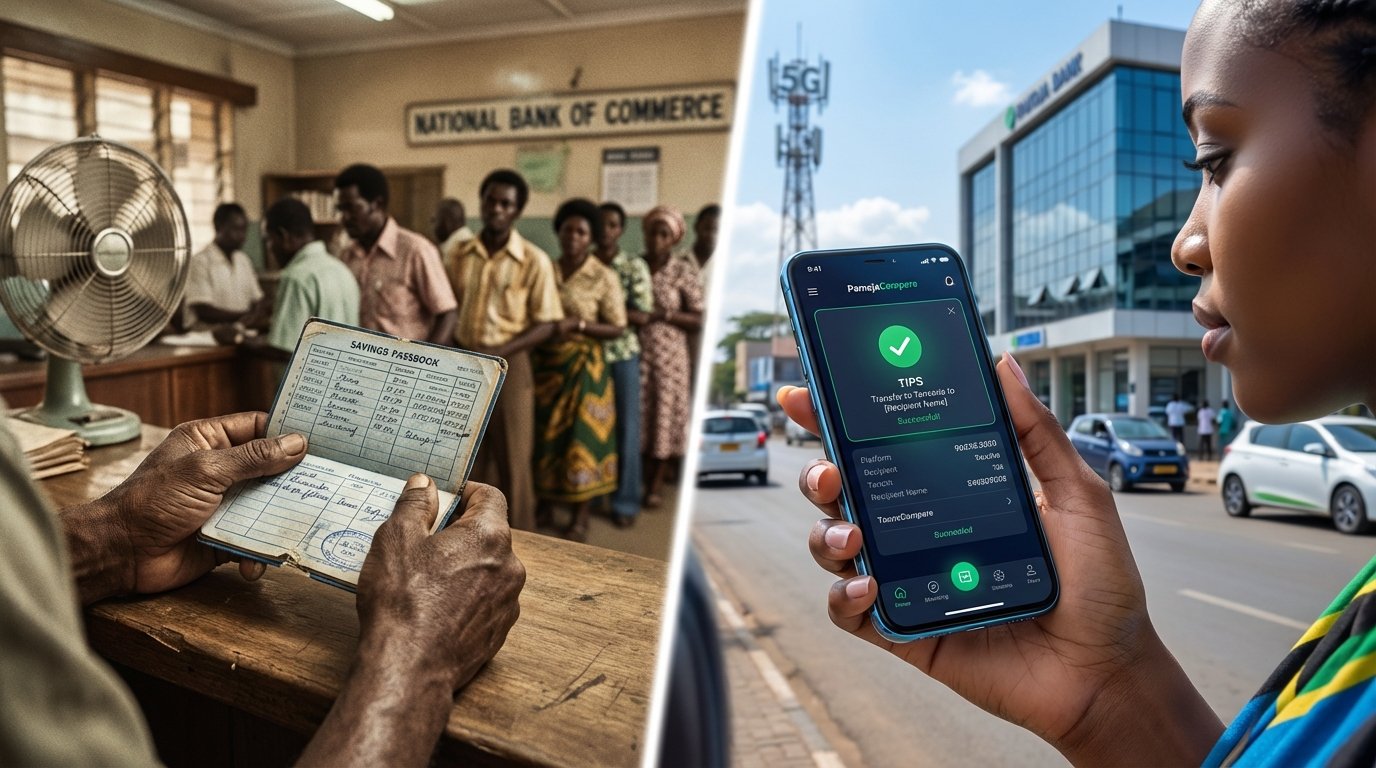
In the mid‑1970s, a visit to the bank could easily swallow an entire day.
Picture a hot Dar es Salaam morning. Ceiling fans barely turn above a packed National Bank of Commerce (NBC) branch. The queue snakes outside, men in khanga and polyester shirts clutching paper passbooks, civil servants lining up for salaries, traders waiting to cash cheques. The teller windows are few, the forms are many, and if you live in a village hours away, this rare trip to town is expensive and stressful.
Fast‑forward to 2026.
A young teacher in Arusha sees her salary hit her account on her phone before the morning assembly ends. She pays her duka with a QR code, tops up her electricity, sends money to her parents in the village, and checks a small digital loan – all from a 5G‑enabled smartphone. The old stone bank buildings are still there, but the “bank” she actually uses lives in her pocket.
How did Tanzania move from nationalized, monopoly banking halls to an era of neobanks and fintechs? The answer is a 60‑year story of policy choices, technology, and the quiet determination of ordinary Tanzanians to bend the system to their needs.
Era 1: The Arusha Declaration (1967–1991)
Nationalization and the NBC monopoly
In 1967, the Arusha Declaration set Tanzania on a socialist path. Within days, the government nationalised all commercial banks in the country, folding foreign and locally owned banks into a new state giant: the National Bank of Commerce.
Key milestones in this era included:
- 1967: Arusha Declaration announces “socialism and self‑reliance.”
- 1967: Commercial banks are nationalised and merged into NBC.
- 1970s–1980s: NBC becomes the dominant provider of formal banking services.
For policymakers, the goal was to use a single public bank to channel credit into priority sectors like agriculture, state enterprises, and cooperatives. For ordinary citizens, especially in rural areas, it often meant formal banking was something that happened in distant town centres and government offices, not in everyday life.
What this meant for the unbanked majority
Under NBC’s monopoly, banking was:
- Centralised: Decisions about credit and branches were made in Dar es Salaam, not in villages.
- Document‑heavy: Formal employment, collateral, and paperwork were usually required.
- Urban‑biased: Branches clustered in cities and major trading centres, leaving large rural areas with little or no access.
Most Tanzanians continued to rely on cash, rotating savings groups, and informal lenders. The “bank” was something you visited occasionally, if at all, not a service woven into daily life.
Era 2: The Big Opening (1991–2000s)
Liberalisation and the return of private banks
By the late 1980s, the limitations of a state‑dominated banking system were clear: non‑performing loans, weak competition, and little innovation. In the early 1990s, Tanzania shifted course.
The Banking and Financial Institutions Act of 1991 opened the sector to competition. It created a modern regulatory framework, set rules for licensing, and allowed foreign and domestic private players to enter.
Key milestones in the “big opening”:
- 1991: Banking and Financial Institutions Act passed, liberalising the sector.
- Early 1990s: Foreign banks such as Standard Chartered and Citibank return.
- Mid‑1990s: New private and joint‑venture banks begin to appear.
Suddenly, NBC was no longer the only game in town.
CRDB, NMB and the new banking map
Reform did not stop with opening the door to new entrants. The government also restructured the state‑owned banks themselves.
Important turning points:
- 1996: The Cooperative and Rural Development Bank (CRDB) is restructured and becomes the first state‑owned bank to be privatised.
- 1997: The original NBC is split into two: a new commercial‑focused NBC and the National Microfinance Bank (NMB), designed to serve smaller customers and rural areas.
- Late 1990s–2000s: Privatization and strategic partnerships bring new capital and management into NBC, NMB, and CRDB.
This era created the modern “big three” pillars of Tanzanian banking – CRDB, NMB, and NBC – alongside a growing ecosystem of foreign and regional banks.
Era 3: The Mobile Leapfrog (2008–2020)
M‑Pesa and the branchless revolution
In 2008, Vodacom Tanzania launched M‑Pesa, bringing to Tanzania a mobile‑money model already tested in Kenya. At first, it was simply a way to send money across distance: a digital alternative to buses, envelopes, and trusted drivers.
Over the next decade, mobile money transformed into a parallel financial system:
- 2008: M‑Pesa launches in Tanzania.
- Early 2010s: Airtel Money, Tigo Pesa, and other services join the market.
- Mid‑2010s: Mobile money agents spread nationwide, turning kiosks and dukas into cash‑in/cash‑out points.
Instead of asking customers to come to branches, mobile money put basic financial services in people’s pockets.
How mobile money changed the numbers
The impact on financial inclusion was dramatic. FinScope surveys show that between 2017 and 2023, formal financial inclusion in Tanzania rose from around two‑thirds of adults to more than three‑quarters, and the single biggest contribution came from mobile money. Over that period, the share of adults using mobile money jumped into the 70‑percent range.
Era 4: The 2026 Neobank Revolution
TIPS: the invisible rails under every tap
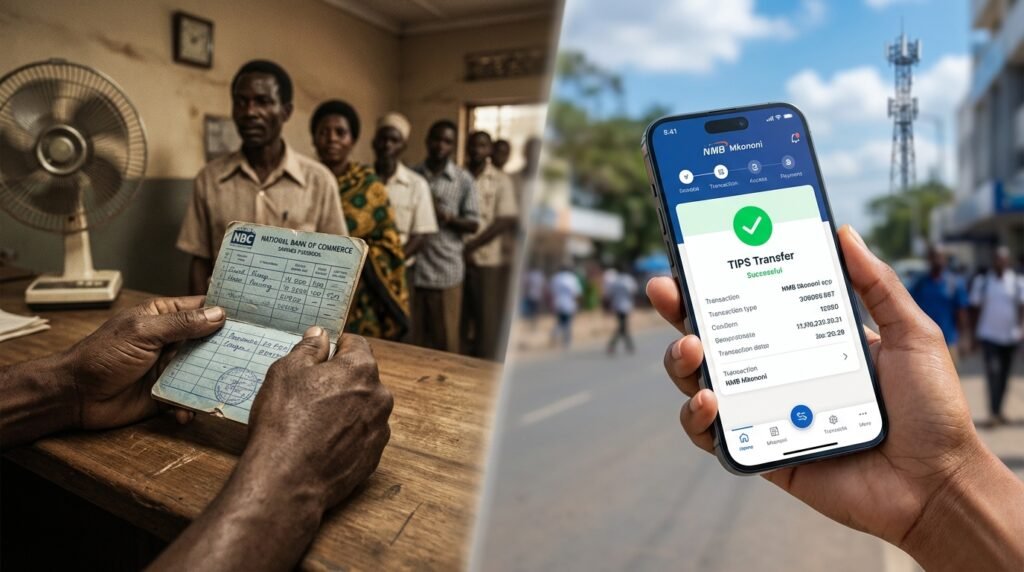
The Tanzania Instant Payment System (TIPS), run by the Bank of Tanzania, is a real‑time payment switch that connects banks, mobile‑money operators, and fintechs. Instead of each provider building its own closed loop, TIPS makes it possible to send money instantly across providers – bank‑to‑wallet, wallet‑to‑bank, and wallet‑to‑wallet.
By the end of 2024, TIPS was processing well over a million transactions a day. Person‑to‑business payments at dukas have surged as merchants adopt QR codes, knowing they can accept money regardless of which bank or wallet the customer uses.
Pocket banks: NMB Mkononi, CRDB SimBanking and the M‑Pesa Super App
On top of TIPS, a new generation of “pocket banks” has emerged.
- NMB Mkononi has grown into one of the country’s biggest digital banking platforms. NMB reports that the vast majority of its transactions now run through digital channels rather than physical branches.
- CRDB SimBanking offers neobank‑style features: customers can open full accounts, manage loans, and withdraw cash from ATMs or Wakala without a card.
- The M‑Pesa Super App has turned a USSD service into a multi‑service digital wallet with mini‑apps, savings, and insurance in one interface.
Fintech challengers: NALA, Watu Simu and the new edge
Beyond the big incumbents, specialised fintechs are carving out their own roles in the 2026 ecosystem. NALA focuses on the Tanzanian diaspora, offering an app that lets users in the UK, EU, and US send money instantly back home with transparent fees. Watu Simu targets device financing, having financed around a million smartphones by 2026, allowing customers to pay for handsets in instalments.
Conclusion: The buildings remain, but the power has shifted
Walk through downtown Dar es Salaam or Arusha today and the old bank branches are still there. What has changed is where the real power sits. It no longer rests only with the building; it lives with the user who can compare fees, open accounts instantly, and move money across borders.
PamojaCompare was built for this era of choice. Use our Bank Account Comparison Table to see how these 60 years of history have created the best account for you today.