

The publication of the national budget represents a critical annual milestone for the economic trajectory of the United Republic of Tanzania. In June 2026, the formal reading of the Tanzania budget 2026/27 initiated a pivotal financial transition, focusing on structural development, digital economy formalization, and national self-reliance. For ordinary citizens, this budget directly dictates the cost of living, household electricity access, and daily transaction expenses. For the substantial Tanzanian diaspora residing in countries such as Australia, the United Kingdom, and the United States, the Tanzania financial budget serves as a key indicator of investment conditions, real estate financing viability, and currency stability. Understanding these macroeconomic shifts allows both domestic and international stakeholders to make highly informed personal finance decisions.
Macroeconomic Targets and Key Budget Figures
The financial framework proposed for the 2026/2027 fiscal year outlines a record expenditure plan designed to stimulate stable economic growth while lowering dependency on external assistance. The total budget size is established at TZS 62,334.2 billion (or TZS 62.3 trillion), marking a substantial 10.3% increase from the TZS 56,490.3 billion approved in the 2025/2026 fiscal year.
A central pillar of this budget is the government’s aggressive drive toward fiscal self-sufficiency. Domestically generated revenue is projected to finance 74.2% of the total budget, while foreign aid and development grants are targeted to fall to just 0.9% of spending—a significant decrease from previous years. To bridge the remaining fiscal gap, the government plans to borrow TZS 15,542.9 billion from both domestic and external sources.
| Budget Metric (FY 2026/27) | Projected Value (TZS Billion) | Percentage of Total Budget (%) | Associated Source |
| Total Proposed Expenditure | TZS 62,334.20 | 100.0% | |
| Total Domestic Revenue | TZS 46,791.30 | 74.2% | |
| — Tax Revenues | TZS 36,989.30 | 59.3% | |
| — Non-Tax Revenues | TZS 9,238.80 | 14.8% | |
| External Grants & Foreign Aid | TZS 563.10 | 0.9% | |
| Total Borrowing Requirements | TZS 15,542.90 | 24.9% | |
| — Domestic Borrowing | TZS 6,557.70 | 10.5% | |
| — External Borrowing | TZS 8,985.20 | 14.4% |
This macro-fiscal strategy operates alongside an optimistic real GDP growth target of 6.3% for the 2026 calendar year, compared to a 6.0% average growth rate recorded in 2025. The primary driver for this growth continues to be sustained public investments in flagship projects, notably the Standard Gauge Railway (SGR) and energy distribution networks managed under the Ministry of Energy’s TZS 2.52 trillion developmental budget.
Banking and Financial Sector Implications
The financial sector, dominated by key institutions including CRDB NMB Tanzania, is deeply integrated into budget execution through domestic borrowing channels and tax policy adjustments. In order to meet domestic borrowing targets of TZS 6,557.7 billion, the government will rely heavily on commercial banking liquidity. Fortunately, the domestic banking sector remains highly stable, characterized by strong liquidity and adequate capital buffers.
The non-performing loans (NPL) ratio declined to a recent year low of 2.9%, well below the central bank’s regulatory threshold of 5%. Additionally, private sector credit growth reached a robust 22.8%, indicating healthy demand from local businesses and households.
Tax policy modifications under the Finance Act continue to influence financial services. Corporate tax rates remain structured to reward public listings; companies that list at least 25% of their equity on the Dar es Salaam Stock Exchange (DSE) are eligible for a reduced corporate tax rate of 25% for three consecutive years. Conversely, the 10% withholding tax on undistributed profits after 12 months presents administrative considerations for cash-retaining financial institutions.The implementation of a 5% withholding tax on interest paid to foreign financial institutions also impacts external borrowing costs for local banks.
Impact on Remittances
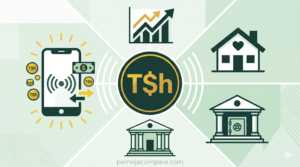
Remittance flows remain a vital pillar of the Tanzanian economy, representing a key source of foreign currency and household support. When evaluating the Tanzania remittance tax landscape, the 2026/27 budget emphasizes digital integration rather than direct taxation on incoming personal remittances. Historically, inward personal transfers are not subject to direct taxation inside Tanzania; however, transaction commissions paid to local agents by mobile money operators are subject to a 10% withholding tax.
To capture and channel these financial flows, major institutions have developed dedicated Tanzania diaspora banking products. For example, CRDB Bank’s Tanzanite Account allows diaspora members to hold accounts in TZS, USD, GBP, and EUR with zero monthly maintenance fees and direct linkages to international money transfer operators (MTOs) like Western Union and WorldRemit.
Similarly, NMB Bank’s Kwetu Diaspora Banking program offers multi-currency accounts and a specialized digital onboarding platform, allowing diaspora members to easily establish compliant banking relationships remotely. Zanzibar has also modernized its registry to coordinate and ease trade and real estate investments for registered diaspora members.
Mobile Money and Fintech
Mobile money services have revolutionized financial inclusion, with the Tanzania Communications Regulatory Authority (TCRA) reporting over 76.47 million active accounts. However, the cost of utilizing these services remains a point of heavy policy discussion. The Tanzania mobile money tax 2026 dialogue continues to address the fiscal paradox of over-taxation. Tanzania remains the only country in East Africa that simultaneously applies an 18% VAT and a 10% excise duty on mobile money transaction fees, pushing the combined effective pre-levy tax rate on fees close to 30%.
Furthermore, a mobile money transaction levy of 0.5% applies to high-value transfers , while previous assessments show that regressive transaction levies on lower-income bands have historically reduced rural household consumption. The East African private sector has actively campaigned for a reduction of airtime and electronic communication excise duties down from 17% to 14% to improve consumer affordability. The government’s mid-term revenue mobilization strategy continues to weigh direct excise collection against the broader economic formalization benefits of traceable, low-cost digital transactions.
What It Means for Savers and Borrowers
Monetary policy and inflation management are critical determinants of interest rate trajectories. In the first half of 2026, the Bank of Tanzania kept the Central Bank Rate (CBR) steady at 5.75%. To improve policy transmission, the Monetary Policy Committee narrowed the CBR corridor from 200 basis points to 150 basis points, setting the 7-day interbank rate target band at 4.25% to 7.25%.
Inflation remains well-controlled, averaging 3.3% in Mainland Tanzania during Q1 2026, though rising transport and fuel prices pushed headline inflation to 4.0% in April 2026. To understand the real returns on savings, the Fisher equation is expressed as:
where $r$ is the real interest rate, $i$ is the nominal interest rate, and $\pi$ is the inflation rate. With inflation hovering within the target range of 3.0% to 5.0%, savers using standard savings accounts must seek high-yield deposit instruments to ensure positive real returns.
For borrowers, the combination of steady policy rates, strong credit growth (22.8%), and stable bank liquidity suggests that credit remains highly accessible, though borrowing costs are expected to remain stable and moderately high as banks manage credit risks.
Key Takeaways for the Diaspora
For Tanzanians living abroad, the macro-fiscal direction of the country presents distinct opportunities and administrative obligations.
Stable Investment Environment: Keeping the fiscal deficit below 3.0% of GDP and managing inflation supports currency stability, protecting the value of remittances and investments sent home.
Dedicated Banking Solutions: Utilizing specialized accounts like CRDB’s Tanzanite Account or NMB Kwetu Diaspora Banking provides free access to digital platforms, high-end debit cards, and dedicated relationship managers.
Embedded Insurance Protections: Specialized diaspora accounts frequently include embedded benefits. CRDB’s Tanzanite Account offers “KAVA Assurance,” providing up to TZS 50 million in life assurance, total disability, and body repatriation benefits for self and spouse at no additional cost. Similarly, NMB Kwetu provides built-in life insurance and repatriation coverage underwritten by Sanlam Life Insurance.
Sovereign & Real Estate Investment: The budget’s heavy emphasis on infrastructure and domestic borrowing means that diaspora members can securely invest in government treasury bonds or utilize structured mortgage programs, such as CRDB’s “Jijenge Mortgage” which offers up to 20-year repayment terms in either TZS or USD.
Conclusion
The fiscal year 2026/2027 budget represents a clear stride toward economic self-reliance, infrastructure optimization, and structured financial sector expansion. While mobile money levies and localized tax adjustments require careful planning, the macroeconomic stability achieved under low inflation and robust banking sector health provides a favorable climate for both domestic citizens and international diaspora members.
Identifying the best bank Tanzania 2026 has to offer depends heavily on individual financial needs, whether seeking high-yield savings, affordable borrowing rates, or seamless international transfer capabilities. PamojaCompare (pamojacompare.com) offers a comprehensive, user-friendly comparison platform, allowing users to evaluate Tanzanian banking options, compare interest rates, and make highly informed financial decisions.