

Overview of Airtel Tanzania’s Market Position
Tanzania’s mobile market is one of East Africa’s most competitive, and Airtel Tanzania sits firmly at its centre. According to TCRA statistics for Q4 2024, Airtel held approximately 23.4% of mobile subscriptions — roughly 20 million lines making it the third-largest operator. Total mobile subscriptions in Tanzania surpassed 65 million by the end of 2024, reflecting a 33% surge in internet subscriptions across the year. Notably, TCRA’s Quality of Service assessments recently rated Airtel as a top-tier provider with a 98% QoS score, reinforcing its reputation for network reliability.
The Celtel Era (2001–2008)
Licensing and Launch
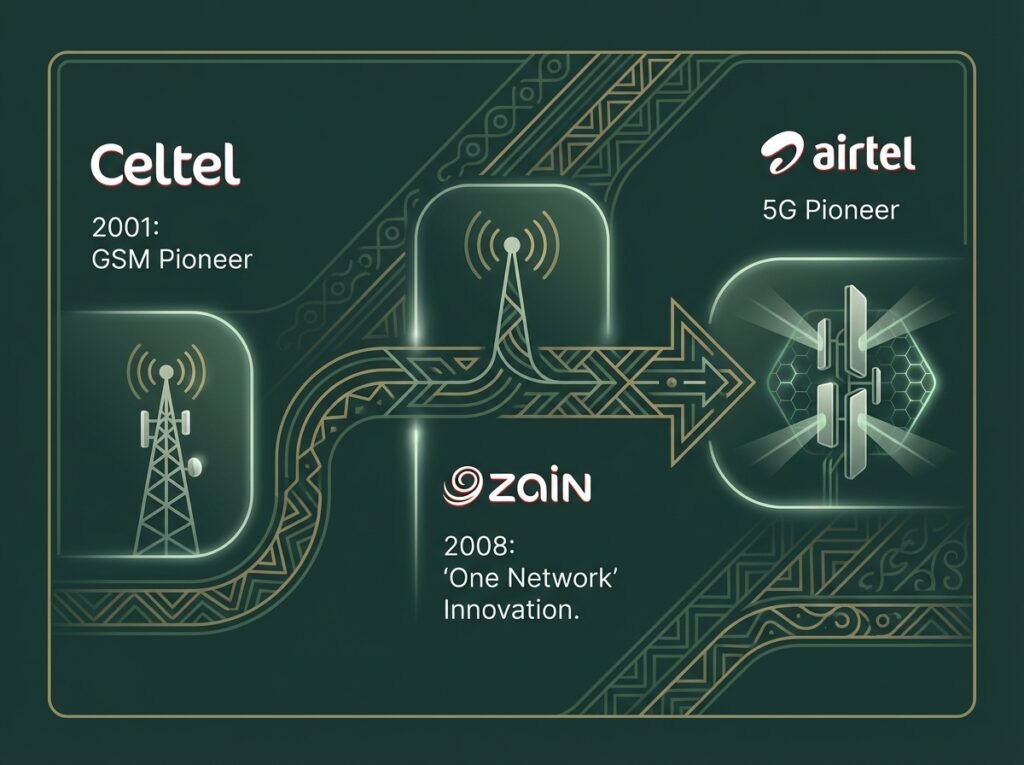
Airtel Tanzania traces its origins to Celtel Tanzania, which emerged from the partial privatisation of Tanzania Telecommunications Company Limited (TTCL) in 2001. Celtel received its national mobile licence and launched GSM 900/1800 services that same year. A full corporate separation from TTCL was completed in 2004, allowing Celtel to raise independent capital and accelerate its network rollout across the country.
Early Competition and Regional Connectivity
When Celtel entered the market, it faced established players like Mobitel (later Tigo) and Tritel. Celtel differentiated itself through aggressive coverage expansion and regional connectivity. By the mid-2000s, Celtel had introduced GPRS/EDGE packet data services — the first Tanzanian operator to do so at scale — laying the foundation for future mobile internet growth.
The Zain Transition (2008–2010)
Rebranding to Zain
In August 2008, Kuwait-based Zain Group rebranded all of its African Celtel operations, including Tanzania, under the unified Zain brand. This move was part of an ambition to build a top-ten global telecoms group, leveraging economies of scale in roaming and marketing across more than 20 markets.
The “One Network” Innovation
Celtel and Zain are credited with one of Africa’s most celebrated telecom innovations: One Network. Launched in East Africa in 2006, this borderless roaming service allowed customers in Kenya, Uganda, and Tanzania to roam without surcharges, make calls at local rates, and receive incoming calls for free. This innovation cemented the subsidiary’s appeal to Tanzanian diaspora communities and cross-border travellers.
Bharti Airtel Tanzania Ownership (2010–Present)
The Bharti Airtel Acquisition
In 2010, India’s Bharti Airtel acquired Zain’s entire African operations in a landmark deal. The Tanzanian unit was rebranded as Airtel Tanzania, joining an Africa-wide network that today spans 14 markets. Initially, Bharti Airtel inherited Zain’s 60% stake, while the Government of Tanzania retained 40%.
The 51/49 Ownership Split
Ownership was a point of negotiation for years. In 2019, Bharti Airtel and the Tanzanian government formally agreed to restructure the shareholding to a 51% (Bharti Airtel) / 49% (Government of Tanzania) split. This hybrid ownership model is frequently cited as a balance between attracting global investment and protecting national economic interests.
Airtel Money Tanzania: History and Digital Finance
From Zap to Airtel Money
Zain introduced a mobile money platform called “Zap” in 2009. Following the 2010 acquisition, it was re-launched as Airtel Money, evolving from a basic wallet into a comprehensive digital financial ecosystem. Today, it is one of Tanzania’s three dominant mobile money platforms.
Interoperability and Remittances
Airtel Money was an early mover on interoperability, enabling direct wallet-to-wallet transfers with other networks. For the diaspora, partnerships with international remittance services like WorldRemit opened corridors to over 50 countries. Recently, Airtel added micro-loans and overdraft products, such as the Kamilisha service, to expand financial inclusion.
From 3G to Airtel 5G Coverage
3G and 4G Rollout
Airtel Tanzania launched 3G in December 2008, enabling higher-speed data for early smartphone users. The 4G/LTEnetwork followed in November 2019, after Airtel acquired a full licence and committed to expanding LTE to 25 additional towns.
Airtel 5G Launch
In October 2022, Airtel acquired 140 MHz of spectrum for approximately US$60.1 million to support 5G. The company officially launched commercial 5G services in August 2023, becoming Tanzania’s third 5G operator. This rollout included the introduction of the 5G Smart Box, providing fixed-wireless broadband alternatives for households and SMEs.
Infrastructure and Rural Coverage
Airtel’s infrastructure investments have translated into significant market gains. According to reports from The Citizen, its multi-band spectrum portfolio provides a balanced strategy for both urban capacity and wide-area rural reach. Furthermore, the 2Africa subsea marine cable connection is expected to lower international bandwidth costs, keeping mobile data tariffs affordable for the long term.
Airtel’s Role in Tanzania’s Digital Economy
Over 24 years, Airtel Tanzania has evolved from a late-entrant GSM player into a core pillar of the country’s economy. With a 51/49 ownership structure that aligns with national development goals, it continues to shape how millions access data and financial services. For Tanzanians evaluating network options, Airtel’s history of innovation and ongoing 5G investment makes it a major long-term player in the nation’s digital story.
Key Airtel Tanzania Milestones
| Year | Milestone | Significance |
|---|---|---|
| 2001 | Celtel Tanzania launches | Enters market following TTCL privatisation. |
| 2004 | Full separation from TTCL | Allows for independent capital and faster rollout. |
| 2006 | One Network Launch | First borderless roaming service in East Africa. |
| 2008 | Rebranded to Zain | Part of a global African unification strategy. |
| 2008 | Commercial 3G Launch | W-CDMA 2100 MHz services introduced. |
| 2010 | Bharti Airtel Acquisition | Airtel Tanzania brand era officially begins. |
| 2010 | Airtel Money Launch | Replaces “Zap” as the core mobile finance tool. |
| 2019 | 51/49 Ownership Deal | Government stake increases to 49% after negotiations. |
| 2019 | 4G LTE Rollout | Major national expansion of high-speed data. |
| 2022 | Spectrum Acquisition | $60.1M invested for 5G readiness via TCRA. |
| 2023 | Commercial 5G Launch | High-speed 5G and Fixed Wireless Access (FWA). |
| 2024 | 5G Smart Box Launch | Unlimited home plans targeting SMEs and households. |
Understanding Airtel’s history provides the context for its current infrastructure, but for most users, the final choice depends on real-time speed and cost. Whether you are a local resident looking for a 5G Smart Box or a member of the diaspora setting up a home connection for family, it is essential to compare current tariffs. To see how Airtel’s latest data packages and 5G plans stack up against competitors like Vodacom or Yas, visit our Tanzanian Internet Comparison page to filter by technology, coverage, and monthly fees.