
Background
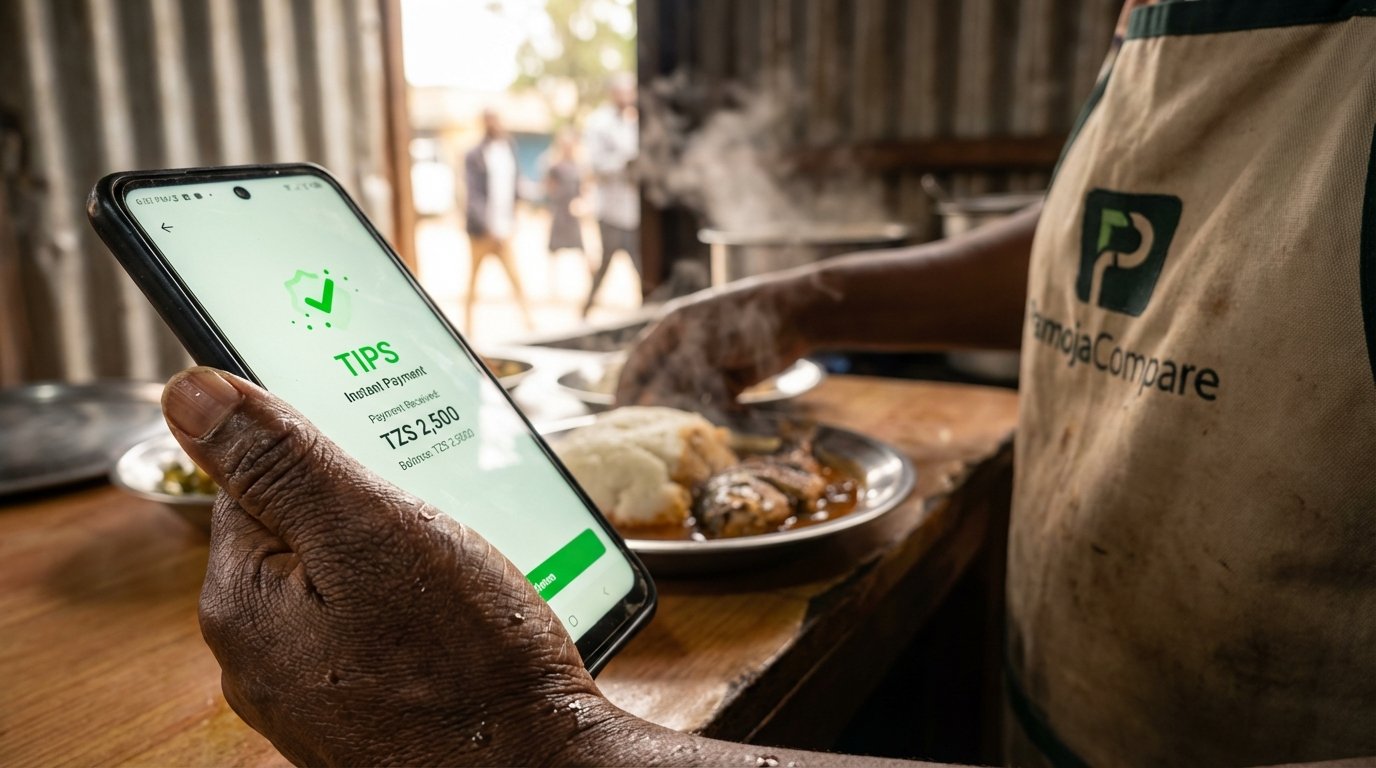
On a hot Tuesday afternoon in Arusha, a mama lishe at a roadside kibanda finishes serving lunch and reaches for something more powerful than the cash box her mother relied on.
It is not a ledger, or a receipt book.
It is a low‑cost Android smartphone.
She checks a Songesha overdraft balance, receives a TIPS‑enabled payment from a customer’s Airtel Money wallet, then sends a small repayment to her M‑Pawa loan – all before the next plate of ugali leaves the stove.
Scenes like this are no longer exceptions in Tanzania; they are becoming the default. The “digital dividend” of the 2020s is not just about more people being online – it is about the economy itself quietly relocating into the handset.
From towers to TIPS: how the rails were laid
Ten years ago, it was still common to drive for hours in rural Tanzania and lose signal between villages. Today, the situation is almost reversed.
By late 2024, 4G networks covered around 88 percent of the population and more than 70 percent of the country’s land area, with 5G already reaching roughly one‑fifth of Tanzanians and expanding rapidly in 2025. Behind those percentages sits a very physical story: steel towers, concrete bases, and thousands of kilometres of fibre.
In 2023 the government signed contracts with Vodacom, Airtel, Tigo (now Yas), Halotel and TTCL to build 758 new rural towers and upgrade more than 300 old ones to 3G and 4G. The Universal Communications Service Access Fund (UCSAF) subsidised a big share of the cost, and by mid‑2025 about 90 percent of those towers were complete, reaching an estimated 8–8.5 million people who previously had little or no signal.
At the same time, operators have been restructuring their balance sheets to focus on coverage and capacity. Vodacom’s 2024 deal to sell over a thousand towers to Helios Towers freed capital for more 4G and 5G upgrades, even as it acquired extra spectrum from Smile Communications. Airtel has signed new UCSAF “Phase 10” agreements to build more than 130 additional towers in mining and farming communities, targeting exactly the places where digital finance can unlock value in the informal economy.
On top of the towers sits a more invisible but equally important layer: real‑time payment rails. The Tanzania Instant Payment System (TIPS), operated by the Bank of Tanzania (BoT), now acts as a national switch linking banks, mobile money operators and fintechs. In 2024 alone, TIPS processed around 450 million instant transactions worth close to TZS 30 trillion, its volumes growing by more than 90 percent year‑on‑year.
If the towers are the physical skeleton of the digital dividend, TIPS is its bloodstream.
From “under the mattress” to “in the phone”
The second pillar of Tanzania’s smartphone shift is the quiet revolution in financial inclusion.
FinScope Tanzania 2023, the country’s flagship demand‑side survey, shows that formal financial inclusion has risen from 65 percent of adults in 2017 to 76 percent in 2023. Over the same period, reliance on purely informal mechanisms – like unregistered savings groups and local moneylenders – has dropped from 35 percent of adults to about 24 percent.
The biggest driver of that shift is not bank branches. It is mobile wallets.
FinScope finds that about 72 percent of adults now use mobile money, compared to just 22 percent who use banking services. In simple terms, that is roughly 24.4 million adults with a mobile wallet versus about 7.5 million who are “banked.” BoT’s own supply‑side data shows over 51.7 million registered mobile money accounts in 2023, supported by more than 1.2 million mobile money agents – dwarfing the roughly 1,000 traditional bank branches in the country.
Mobile banking apps are growing as a bridge between the two worlds. Between 2020 and 2024, mobile banking subscribers increased from about 5.9 million to 9.5 million, and the value of app and USSD‑based mobile‐banking transactions climbed to nearly TZS 30 trillion in 2024. In practice, it means a growing minority of Tanzanians now relate to their bank through the handset, not the queue.
As towers push deeper into rural Tanzania and agents multiply, BoT’s TanFiX index (a composite measure of access and usage) has risen from 0.68 in 2022 to 0.81 in 2024, signalling not just more accounts, but more meaningful use of digital finance.
The rise of nano‑loans: when credit shrinks to fit the screen
Credit used to mean forms, guarantors, and waiting. Now it often means a few taps.
BoT’s 2024 Annual Financial Inclusion Report shows that the number of digital loan accounts – mostly tiny, short‑term “nano‑loans” delivered through mobile phones – doubled in 2024 to about 193 million, up from roughly 96 million the year before. The value of these loans rose from about TZS 126 billion in 2023 to roughly TZS 227 billion in 2024, an increase of about 80 percent.
Zoom out to the entire payment system, and the picture is even starker. Mobile‑based digital credit transactions (covering products like M‑Pawa, Songesha, Timiza, Nivushe, Kamilisha and others) almost doubled in value from TZS 2.20 trillion in 2023 to TZS 4.22 trillion in 2024, with transaction counts growing from about 163 million to 269 million.
Vodacom’s own ESG reporting illustrates how mainstream these products have become. In the year to March 2024, Vodacom disbursed around TZS 81 billion in M‑Pawa loans, up from about TZS 54 billion the previous year. Its Songesha overdraft product supported an outstanding lending portfolio of roughly TZS 703 billion, and agent overdrafts such as Wakala Songesha and Wezesha Wakala channelled well over TZS 1 trillion to keep M‑Pesa agents liquid.
Traditional banks still dominate the overall stock of credit: BoT’s Banking Supervision Report puts total bank loans and advances at around TZS 36.6 trillion in 2024, with personal loans accounting for perhaps TZS 13–14 trillion of that. But in terms of speed, reach and frequency of use, mobile‑based nano‑loans are increasingly how ordinary Tanzanians first “meet” formal credit.
For the duka owner in Mwanza or the boda‑boda rider in Mbeya, a TZS 30,000 nano‑loan that arrives in seconds can be more relevant than a TZS 10 million term loan they can never qualify for.
TIPS and the duka: how P2B is going digital
If nano‑loans are how Tanzanians borrow via phone, P2B (person‑to‑business) mobile payments are how they increasingly spend via phone.
BoT’s payment‑system data shows that mobile payment transactions overall grew by about 27 percent in 2024 to 6.41 billion, while their value rose nearly 29 percent to around TZS 198.9 trillion. That is more than the size of Tanzania’s annual GDP flowing through mobile wallets.
Within that ocean of transactions, P2B is one of the fastest‑growing segments. In 2024, P2B mobile payments grew by roughly 29 percent in volume and almost 46 percent in value, fuelled by the rapid spread of merchant payment points. The number of merchants – from supermarkets to tiny dukas – able to accept digital payments more than doubled to about 1.33 million.
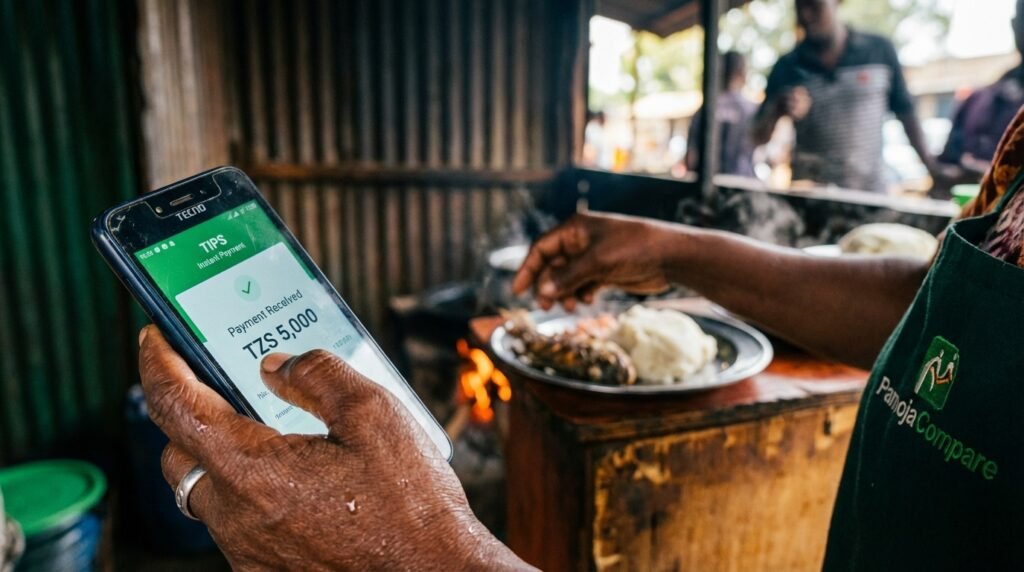
This is where TIPS becomes tangible at the counter. Customer on Vodacom, merchant on Airtel? No problem. Bank account paying mobile wallet? Same story. TIPS routes the payment instantly across providers, so the small trader does not have to care which network the customer is on.
Smartphones vs feature phones: the hybrid reality
Tanzania’s digital economy is still firmly rooted in the feature phone, but the centre of gravity is moving.
FinScope 2023 reports that about 75 percent of adults own a mobile phone, yet only 19 percent own a smartphone. Network statistics tell a faster story. TCRA data shows smartphone penetration rising from roughly 15 percent of the population in 2021 to about 32–36 percent by 2024, with around 25.4 million smartphones active in the country by early 2025.
By late 2025, smartphone penetration had edged toward 40 percent, even as feature‑phone penetration remained high (over 80 percent) because many people own more than one SIM or device. In practice, this yields a smartphone‑to‑feature‑phone ratio of roughly 1:2.
Financing the smartphone wave
If connectivity and payments are the rails, and nano‑loans the fuel, smartphones are the driver’s seat.
High handset prices have long been a barrier. That is changing fast. Programmes like Vodacom and Samsung’s “Miliki Simu, Lipa Mdogo Mdogo” let customers walk out of a shop with a 4G smartphone after a small down payment and pay the rest in daily or weekly instalments through M‑Pesa.
Vodacom and CRDB have gone further by offering formal smartphone‑financing loans, again repaid digitally. Yas (formerly Tigo) has partnered with ZTE on its own low‑cost smartphone‑on‑instalment offers. New players like Watu Simu add another layer, having financed around one million smartphones by early 2026 under pay‑as‑you‑go models.
What this means for banks, fintechs and PamojaCompare
For banks and mobile‑money providers, Tanzania’s smartphone shift is both an opportunity and a test. Customers now judge providers not just on safety and fees, but on user experience – app design, USSD simplicity, agent reliability, and TIPS integration.
This is where a platform like PamojaCompare slots into the story. As more Tanzanians and diaspora customers manage their financial lives from a smartphone, they will need simple, trustworthy ways to compare:
- Which banks have the best mobile apps and lowest digital fees.
- Which mobile wallets work best across networks and borders.
- Which providers are most friendly for merchants and gig‑workers.
Looking ahead to 2026 and beyond
If current trends hold, by 2026 Tanzania will have 4G blanketing almost the entire population and 5G in most regional capitals. Around two in every five citizens will be using smartphones.
For ordinary Tanzanians, the digital dividend will not be a single dramatic moment. It will be the cumulative effect of millions of small changes: a mama lishe avoiding a bad day because she can borrow instantly, or a young entrepreneur getting paid via QR code.
The future of Tanzania’s economy is increasingly being negotiated on a 6‑inch screen. Whoever understands that reality first, and designs for it best, will define the next decade.
Recommended External Links
Adding these links helps establish your site as a well-researched authority by connecting readers to official bodies.
- Bank of Tanzania (BoT): * Context: Mention of TIPS or national payment rails.
- Link: https://www.bot.go.tz/
- Tanzania Communications Regulatory Authority (TCRA):
- Context: Mention of 4G/5G coverage or smartphone penetration stats.
- Link: https://www.tcra.go.tz/
- Financial Sector Deepening Tanzania (FSDT):
- Context: Mention of the FinScope 2023 survey.
- Link: https://www.fsdt.or.tz/
- UCSAF (Universal Communications Service Access Fund):
- Context: Mention of the 758 rural towers or government tower contracts.
- Link: https://www.ucsaf.go.tz/
- Watu Simu:
- Context: Mention of smartphone financing and the “one million phones” milestone.
- Link: https://watuafrica.com/tanzania/